
Coal Briquette Production Line:Process, Materials & Equipment Overview
Summary
The production processes of coke briquettes and coal briquettes are highly similar, both based on coking coal and carbon-containing materials. However, compared with traditional coke production, coal briquette production lines feature a simpler process flow, lower investment requirements, and reduced overall production costs. Therefore, before deciding to build a coal briquette plant or enter the coal briquetting business, it is crucial to gain a systematic understanding of the complete coal briquette production process.
Taking the Ireland Coal Dust Briquetting Project as a reference, this article provides a comprehensive analysis of coal briquette production lines from the perspectives of process flow, raw materials, major equipment, and briquette specifications.
I. Coke / Coal Briquette Manufacturing Process
The core manufacturing processes of coke briquettes and coal briquettes are essentially the same and generally include the following steps:
- Raw Material Selection and Preparation
Based on the final application of the briquettes (metallurgy, energy, chemical industry, etc.), suitable coal powder, coke fines, or other carbon-based materials are selected. This step forms the foundation of the entire production process. - Crushing and Grinding
Large raw materials are crushed to the required particle size to ensure uniformity and stability during subsequent mixing and forming stages. - Feeding and Conveying
The crushed materials are continuously and stably conveyed to the mixing equipment through a feeding system. - Mixing and Proportioning
During the mixing stage, appropriate amounts of binders and functional additives are added according to the formulation to improve briquette strength, wear resistance, and combustion performance. - Briquetting and Forming
The mixed materials enter the coal briquette press, where they are compressed under high pressure to form preliminary briquettes. - Drying Treatment
The wet briquettes are dried to remove excess moisture, enhancing product stability and storage life. - Final Shaping and Packaging
By precisely controlling pressure and forming parameters, the size, shape, and density of the briquettes are ensured to meet standards before packaging or further processing.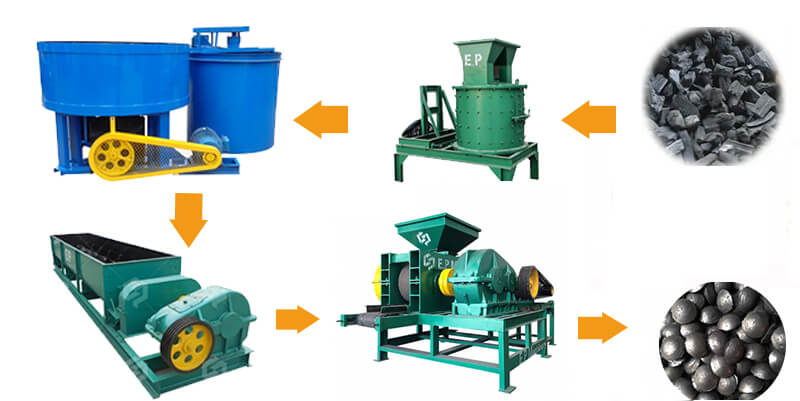
II. Common Raw Materials for Coal Briquette Production Lines
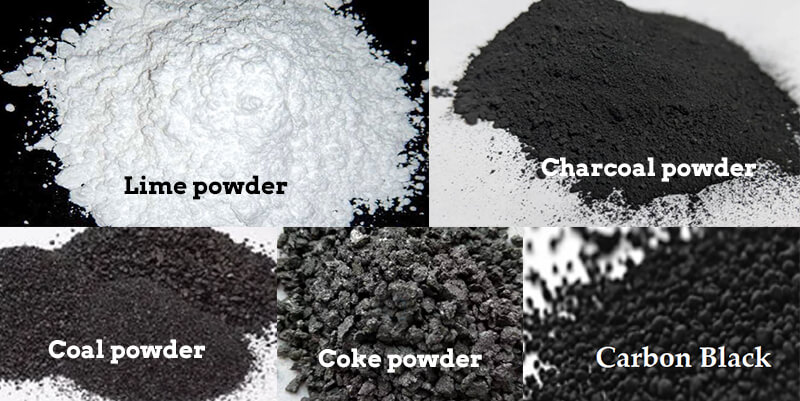
Coal briquette production lines can utilize a wide variety of raw materials, with different formulations designed for different application scenarios:
- Coal Powder: The most commonly used base material, with high calorific value and serving as the primary energy source.
- Charcoal Powder: High carbon content and porous structure, which helps improve combustion efficiency.
- Coke Fines: Low ash content and high calorific value, significantly enhancing combustion performance while reducing emissions.
- Carbon Black: Used to improve mechanical strength and meet certain functional requirements.
- Mineral Powders (manganese ore powder, nickel powder, silicon carbide, etc.): Provide specific chemical or physical properties to the briquettes.
- Lime Powder: Acts as a sulfur-fixing agent during combustion, effectively reducing sulfur dioxide emissions.
III. Main Equipment in Coal Briquette Production
A complete coal briquette production line typically consists of the following equipment:
- Crushing: Reduces large raw materials to the required particle size.
- Screening Machine: Classifies crushed materials by size (optional depending on production requirements).
- Mixing: Ensures uniform mixing of coal powder, binders, and additives.
- Coal Briquette Press: The core equipment that compresses powdered materials into high-density briquettes.
- Dryer: Reduces moisture content to improve briquette stability and durability.
- Belt Conveyor: Connects each processing stage to ensure continuous material handling.
IV. Briquette Sizes and Shapes
Coal briquettes can be customized in various shapes and specifications according to customer requirements. Common mold shapes include:
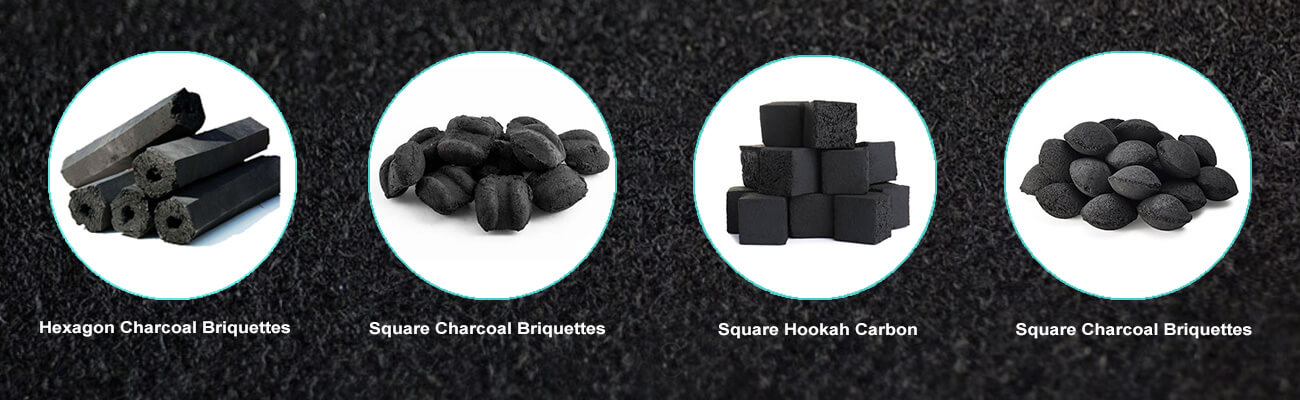
- Cylindrical
- Square
- Spherical
- Pillow-shaped
- Polygonal
Typical Specifications:
- Round Briquettes: Diameter usually ranges from 15–30 mm, offering high combustion efficiency and convenient transportation.
- Square Briquettes: Side length typically 20–40 mm, stable stacking, suitable for high-density loading.
- Column Briquettes: Designed to improve air circulation, ideal for specific combustion equipment.
In actual production, appropriate formulations and process parameters should be selected based on application standards and operating conditions to produce briquettes that fully meet performance requirements.


